
Lucifer in Astrology
The Suppressed Truth About Sovereignty, Self-Mastery & Power
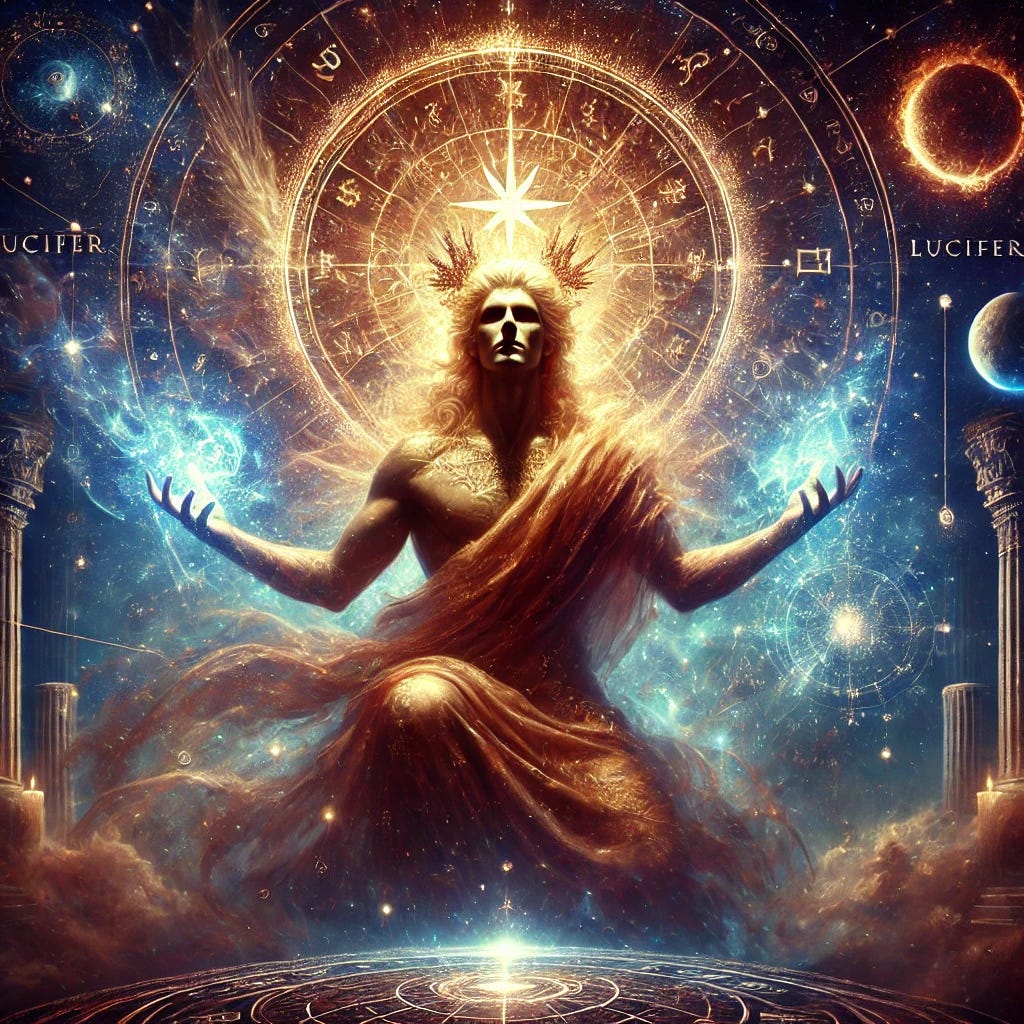
Lucifer. What do you think of when you hear that name? I’m willing to bet that whatever comes to mind, wisdom, freedom and sovereignty are not tops on that list.
Even among astrologers - who you’d think would be free of any dogmatic, religious conditioning - don’t or won’t work with this celestial powerhouse because, well… cultural conditioning against confronting Lucifarian (aka, “evil”) energy. Or the same in their clients.
And that’s too bad. Because Lucifer has a wealth of teachings for us. If we’re open enough to receive them.
That said, what if all of what you thought you knew about Lucifer was wrong? Or at the very least, incomplete? What if the fear and repulsion you were conditioned to feel at the mere mention of that name was a psychological control device? An inversion that represents the epitome of the smoke-and-mirror Piscean Age?
The fact of the matter is, Lucifer has been systematically reshaped by time (and of course, the Church), and - much like the serpent - has been distorted into a symbol of fear and THE representation of evil incarnate. But before the smear campaign (old school “cancelling”), Lucifer symbolized something else entirely. And that “something else” was light, knowledge (and gnosis), and defiance. Not a petulant, strike-matches-to-watch-em-burn defiance, but a mature stiff-arming of the not-Truth that comes from inner wisdom and a deep self-knowing. The kind of mature warrior energy, in fact, that defines sovereignty.
The Lucifer you think you know is, in fact, a manufactured control agent of those you outsource your authority to.
True Lucifarian energy is the warrior-like defiance symbolized by the archetype of Venus as the Morning Star. Not a symbol of wanton aggression, but one of illumination and determination. A celestial presence that disappears (in the glare of the Sun) not through defeat, but through willingly entering the abyss for the express purpose of transformation. Myths and poor - and, intentionally wrong - biblical translation turned Lucifer into the avatar of the arch adversary. The wiley evil one that would seduce you to stray from the “rightious” path. But the ancients knew Lucifer as something entirely different. They knew him as a powerful force who challenges stagnation, questions authority, and opens the door to sovereignty.
If you have the courage to accept it. Lucifer may be the sherpa, but he will never bestow. That you have to seize for yourself.
And while those with prominent morning star Venuses reflect this aspect of defiance, there is a more all-incompassing Lucifarian energy present in everyone’s unconscious mind and, ergo, in their birth chart; Asteroid 1930, better known as Lucifer.
This placement does not show where we fall or where we succumb to the dark side. This placement shows where we refuse to kneel. And, paradoxically, where we choose to fold. The emphasis is on free will; choice. The inflection point. Lucifer marks the place in the chart where we face the tension between true sovereignty and self-destruction, between breaking free or bowing to subservience. I see Lucifer as the ultimate inflection point in our charts.
Lucifer’s placement reveals where we struggle against imposed limitations, whether societal, intellectual, spiritual or self-imposed. It tells us where we challenge external control and where we risk losing ourselves in that fight. When poorly aspected or integrated, Lucifer can manifest as arrogance, rebellion for its own sake, or the illusion of power that is only reactionary. When understood and fully integrated, Lucifer becomes the key to self-mastery, the fire that does not consume but refines and hones.
Lucifer’s story was co-opted and rewritten for control. His meaning was buried beneath a Piscean Age’s worth of dogma and distortion. But the stars are not bound by history’s fears. True astrology does not forget. It does not rewrite. It only reveals.
To trace Lucifer’s path is to uncover a vital and missing piece of the astrological and psychological puzzle. A force that does not submit, does not conform, and does not wait for permission to rise. Unless we choose otherwise.
Lucifer teaches that sovereignty is never given, but it can always be claimed. If you’re willing to shoulder the responsibility for that sovereignty.
So who is Lucifer, really? And what is being represented astrologically by asteroid 1930?
The Name and the Light
Before theological doctrines coopted his name, "Lucifer" simply meant "Light-Bringer." Derived from the Latin "lux" (light) and "ferre" (to bring), it was a poetic term for the planet Venus when she appeared as the Morning Star, heralding the coming dawn.
Lucifer’s association with a fallen angel stems from a misinterpretation of Isaiah 14:12. The original Hebrew text refers to "helel ben shahar," meaning "shining one, son of the dawn," a metaphorical reference to the Babylonian king's demise. However, when translated into Latin as "Lucifer," this morphed into the belief that the passage referred to Satan's fall from grace.
This misinterpretation was further complicated by the New Testament's use of "morning star" to describe Jesus in Rev. 2; 22:1-15 and 2 Pet. 1:19. Thus, the same celestial metaphor came to represent both Christ and a fallen angel, leading to centuries of theological confusion. And creating the kind of sensical questions that would get you quickly booted from Sunday school.
Ironic that the asking of such a question - challenging authority - is the hallmark of Luciferian energy in an astrological sense. As is coming to your own conclusions, regardless of the prevailing consensus. Following your own inner compass. And knowing when your decisions are being made so as to appease authority, or to satisfy your own inner knowing.
So you may be wondering right about now: are we talking about Venus as the morning star… or are we talking about asteroid 1930? These both seem to be representing the same Luciferian energy. So which is it?
Both. And yet, not in entirely the same way.
Venus, the Morning Star, serves as the celestial archetype. An ancient rhythm woven into the sky, the eternal cycle of willing descent into the underworld, transformation, and the return into wisdom and gnosis. This is Lucifer in his primordial form, the pattern (in a Jungian sense) that shaped the myth long before words hardened into dogma and doctrine. But myths do not remain static. They evolve, fracture, and reform. What was once a single meaning becomes many.
Asteroid 1930 (Lucifer) is something different. It is a personal marker of where each of us, regardless of Venus placement, encounter and exhibit Lucifarian energy. Its placement and aspect are specific and sharp-edged. Lucifer marks the place where sovereignty and self-destruction collide—the inflection point where you choose to rise or kneel.
And everyone has a Lucifer placement. Hitler and Mother Tereasa. Jesus, Bhuda, and every 70s serial killer. Lucifer is not about “evil”. Unless bucking convention and cultural conditioning is construed as “evil”. Lucifer is the weight of choice.
Here’s a hint as to what we’re discussing here: the controlling authority loves equating the bucking of that authority with evil. Something to think about. And how you feel about this describes your relationship to this energy.
Confused? I can see why. Two thousand plus years of cultural conditioning will do that.
If Venus is the universal, archetypical myth, then Lucifer’s asteroid is its fingerprint in the natal chart. It does not simply tell the story of light and shadow, it tells your story, showing where you are called to question, where you are driven to challenge, and where you must walk the fine line between self-mastery and self-undoing.
Let’s now drill down further into what your Lucifer placement can reveal. But to do that, we have to first understand the fundamental difference (in astrological and energetic terms) between asteroids and planets.
Planets vs Asteroids
Astrologically, planets and asteroids serve different functions, though they exist on the same spectrum of celestial influence. Planets form the core architecture of a chart (and thus, the personal and collective psyche), shaping identity, drives, and life cycles.
Asteroids, on the other hand, refine, specify, and add nuance to those broader planetary themes. But the difference is more than just a matter of scale—it’s about function, scope, and depth of influence.
One of the key differences is scope. Planets, particularly the slow-moving outer planets, shape generations—Pluto, Neptune, and Uranus imprint themselves across vast societal shifts. By contrast, asteroids are deeply personal, often operating on a level that is intimate and precise. The outer planets for sure hold personal sway. But that sway generally comes from a collective unconscious influence.
As an example, The US’s Pluto return is, and will continue, to deeply affect all of us personally, because the US’s monetary system will be fundamentally upended as a result. Whereas an asteroid transit might mark a highly personalized, single realization. A specific moment of reckoning, a lesson to be learned, within that collapse.
Asteroids do not drive the major movements of the psyche—they define the contours of those movements. They show how, where, and why planetary forces take on certain tones in an individual’s life.
Another way to think of asteroids is through mythological fragmentation. Each planet carries a dominant archetype—Mars is the warrior, Venus is the lover, Mercury is rational thought. But mythology (and psychology) is rarely that simple.
For example, Venus is Aphrodite. But also Isis, Inanna, and Freyja.
And Mars is Ares, but also Horus, Ogun, and the Red Tara.
The planetary system cannot contain all variations of an archetype, so asteroids break them apart into their multifaceted expressions. Instead of seeing one, all-encompassing Venus, we see Juno (marriage), Eros (desire), Pallas (intellect in relationships), and Vesta (devotion over romance).
Lucifer, in this sense, is not just another morning star Venus, Mars, Pluto, or Uranus expression. It is a splintered and specific aspect of rebellion, illumination, and sovereignty that no single planet fully encapsulates.
In this sense, then, Lucifer moves in the space between the planets, not bound to the archetypal cycles of the great celestial bodies, but carving out something sharper, more precise. Lucifer does not govern an age or rule over a zodiacal domain. He illuminates the fracture points, the places where the struggle between obedience and sovereignty plays out within an individual. Lucifer does not dictate, he exposes. Lucifer does not rule, he reveals.
To get a better feel for this, let’s compare and contrast Lucifer to similar energies found within a few planets that represent aspects of the “submit vs sovereignty” dichotomy.
Lucifer, Uranus, and Promethean Rebellion
Lucifer carries the spark of rebellion, but not always the fire to sustain it. This is where Uranus enters. Uranus shatters, liberates, and overturns. Yet where Uranus represents sudden upheaval, Lucifer questions before the break, lingers in the liminal space between doubt and action. Uranus destroys shackles in an instant; Lucifer makes you see them for what they are, forces you to ask why they were ever placed upon you at all. And why you accepted them.
Here, Lucifer aligns with Prometheus, the god who stole fire, chose to give it to mankind, and suffered for it. He is not simply the force of revolution, he is the internal friction bearing the responsibility of “knowing too much”, of realizing that once the fire has been seen, it cannot be unseen. Where Uranus overthrows without hesitation, Lucifer lingers, wrestling with the burden of that illumination. Some reject it outright. Some accept the responsibility, and wield it. And some, caught in between, burn in the weight of their own indecision. Or, willingly choose the “safety” of shackles over the burden of sovereignty.
Lucifer vs. Pluto: Fire or Oblivion?
Pluto, the god of the underworld, does not ask - he takes. He does not bring the light of defiance; he demands complete annihilation. Pluto is the black hole that consumes and reforms, the descent into shadow from which only the truly transformed return.
Lucifer, by contrast, does not seek to destroy—but to challenge. Pluto is raw power, absolute control, the inevitability of death and rebirth. Lucifer is resistance, the space before the fall, the choice between submission and sovereignty.
When Lucifer and Pluto meet in aspect, the struggle intensifies: Is the ego willing to be undone? Is rebellion a path to power, or a means of self-destruction? Pluto will strip away the illusion of control, but Lucifer will force the realization that the chains were always voluntary. One burns, the other obliterates. The outcome depends on which fire is embraced.
Lucifer vs. Saturn: The Chains and the Illusion of Servitude
Saturn binds, establishes, reinforces. He is the architect of laws and the enforcer of consequence. Yet what is Saturn’s greatest illusion? That its chains are unbreakable. Saturn imposes order; Lucifer dares to question why that order exists in the first place.
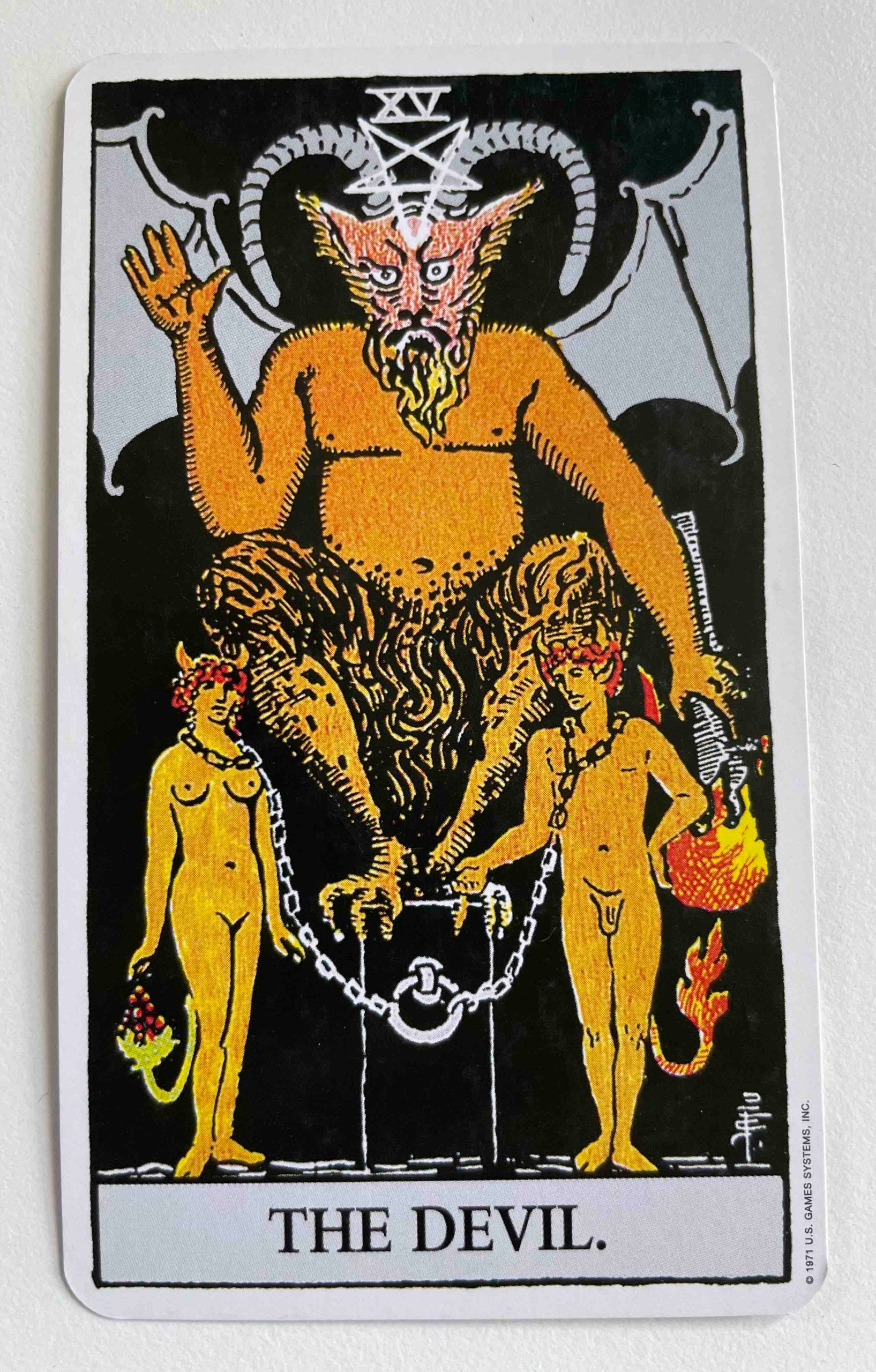
Saturn in aspect to Lucifer creates a tension between obligation and defiance, between accepting structure and seeing it as a cage. Those with this placement may wrestle with internalized authority, with the deep-seated fear that to break free is to be cast out entirely. And yet, what does the Devil card in Tarot reveal? The chains are loose. They can be removed. Servitude remains only as long as one believes in it.
Lucifer vs. Neptune: The Veil and the Fall into Self-Deception
Neptune is the dissolver, the dream weaver, the mist that makes truth slippery and illusion more comforting than reality. Lucifer is the challenge and the courage to see clearly. But what happens when Lucifer’s fire meets Neptune’s fog? Here, rebellion can become delusion, enlightenment can slip into self-aggrandizement, and the search for truth can spiral into deception.
This is the danger of the false prophet, the self-proclaimed liberator who has mistaken their illusions for wisdom. Lucifer in aspect to Neptune may indicate a struggle with discernment: when is the revelation real, and when is it just another comforting mirage? To integrate these two requires an ability to hold light steady within the mist, to question without falling into paranoia, to seek without drowning in the abyss of endless questioning.
Lucifer’s role in the natal chart is not fixed fate—it is a threshold. Lucifer does not push, he presents a choice. He illuminates the sometimes painful truth that there is always a choice. To see, or to turn away. To resist, or to submit. To wield the fire, or to fear it. The answers are never given outright. They must be forged.
Lucifer in the Natal Chart: The Mark of Sovereignty… or of Self-Undoing?
Lucifer in the natal chart highlights the paradox of illumination vs defiance, and sovereignty vs self-undoing. By house placement, Lucifer marks the place where one questions authority, resists conditioning, and struggles with the tension between personal truth and imposed order. But this is also the place where one can be blinded by pride, ensnared by self-deception, or consumed by rebellion for its own sake.
Lucifer’s placement reveals where an individual will wrestle with the following themes:
The urge to challenge, to question, to expose the illusions that others accept as truth
The tension between self-mastery and defiance. Do you lead toward a defined outcome, or do you rebel without knowing what will be built after the rebellion is won?
The potential for great insight, but also for self-sabotage
The danger of arrogance. That is, mistaking illumination for infallibility
The call to carve one’s own path, but at what cost?
Lucifer does not dictate rebellion, nor does it demand submission. He simply reveals an inflection point. The place where sovereignty, if it is to be had, must be claimed. There is no in between with Lucifer. You either claim sovereignty, or wear the chains.
Where Lucifer sits in the natal chart is where the native will not accept control without question. This does not mean they will always resist—it means they will always examine, always see the cracks in the system, always recognize the chains, even if they choose to wear them. For example:
Lucifer in the 1st House: The individual is the embodiment of the challenger, instinctively questioning every external force that attempts to shape them.
Lucifer in the 10th House: The struggle is with societal structures, authority figures, the very concept of hierarchy itself.
Lucifer’s house placement shows where the individual feels the deepest need to assert their independence, and where they are most likely to either break free—or succumb to self-doubt or servitude.
Lucifer serves up tests of self-mastery. A lesson in when to harness and hold power rather than to fight against it. This placement can indicate where one may mistake opposition for wisdom, or contrarianism for truth.
Lucifer in the natal chart reveals where one must take ownership of their own sovereignty, rather than simply rejecting imposed structures. This is the Nietzschean challenge of Lucifer. That is, to rise above rather than simply tear down. The idea being that true sovereignty is not reactionary, it is self-defined.
Or in the words of former US Speaker of the House, Sam Rayburn,
Any jackass can kick down a barn, but it takes a good carpenter to build one.
If poorly integrated, Lucifer can manifest as self-sabotage, self-undoing, unchecked arrogance, or the illusion of invincibility. This is where the myth turns inward, where one becomes their own worst adversary. Lucifer will highlight where one willingly hands over their sovereignty, becoming the victim of evil, or the “devil out there”. “The Devil made me do it” syndrome.
Lucifer will not let you off so easily. You may ultimately point at the Devil, but Lucifer will be there to hold the mirror to your face.
Where does Lucifer burn in your chart? Where do you resist? Where do you kneel?
Book a consult—we won’t just find it. We’ll forge it into fire.
–Keith